




ORGANS OF PARIS © 2026 Vincent Hildebrandt HOME ALL ORGANS



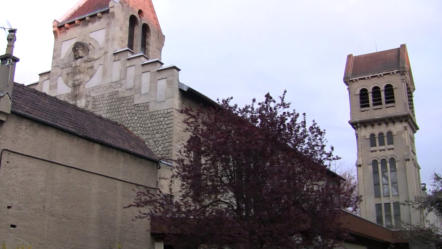



At the beginning of the 20th century, the Bécon-les-
Bruyères district had only the Saint-Charles chapel.
A donor then offered a plot on Rue Armand-
Silvestre in memory of her son Maurice, a very well-
known and deeply religious lawyer. The
construction of the new building was then
entrusted to the architect Julien Barbier, and it took
place between 1907 and 1911. The church is in a
neo-Romanesque style and is mainly built of
reinforced concrete. The center of the façade is
decorated with a sculpture of Christ with
outstretched arms. The nave is preceded by a
narthex and ends with a flat apse.
C3
1865
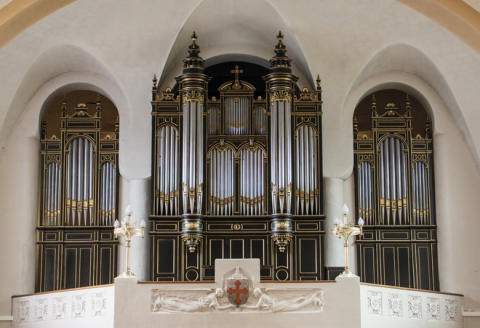
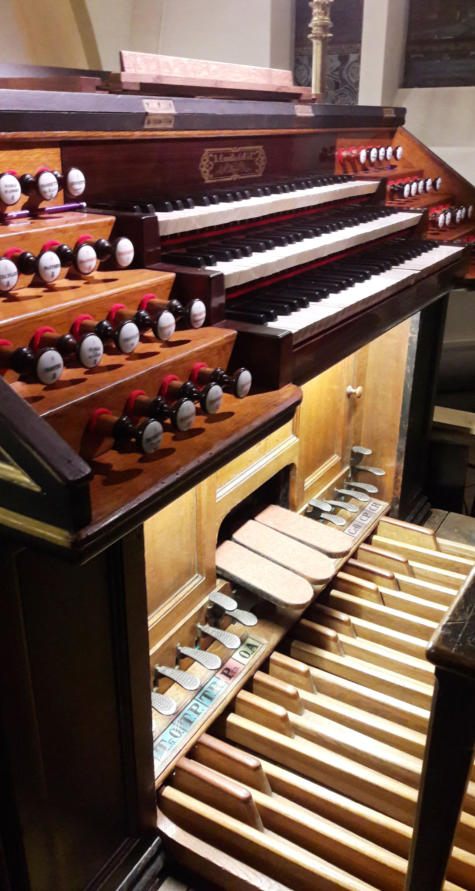
The grand organ of Saint-Maurice was originally built in
1865 by Aristide Cavaillé-Coll for the private chapel of the
Marquis Ernest-Marie-Charles de Lambertye in Gerbéviller
(Meurthe-et-Moselle).
The organ was built in 1865 by Aristide Cavaillé-Coll for the
palatine Chapel of the marquis de Lambertye in Gerbéviller.
Since this instrument was not intended for a church,
Cavaillé-Coll could give free rein to his creativity. The
instrument had a Physharmonica, a stop designed by the
German builder Walcker: a free reed without pipes, as in a
harmonium. There was also a swell box with two opposed
shutters, one opening while the other closes, creating an
effect of moving away from the sound, as in a German
Fernwerck. There were also German influences in the
stoplist, as evidenced by the names of some stops. Cavaillé-
Coll used in this organ for the first time expression pedals,
instead of the spoon like devices used before.
Ernest-Marie-Charles de Lambertye died on 23 February
1904; his nephew and heir then decided to part with the
organ, which was considered cumbersome, in order to
improve the financial situation somewhat. It was purchased
in 1909 by Canon Oudin and installed in t
he new church of Saint-Maurice in Bécon-les-Bruyères. The
instrument was transferred there by Mutin in 1912-1913,
after some alterations (changes to the internal layout and
probably to the wind pressures).
After 1925, the Physharmonica disappeared.
In 1976, the organ builder Jean Jonet carried out some
unfortunate modifications that shifted the instrument’s
specification toward the then-fashionable neo-classical
style.
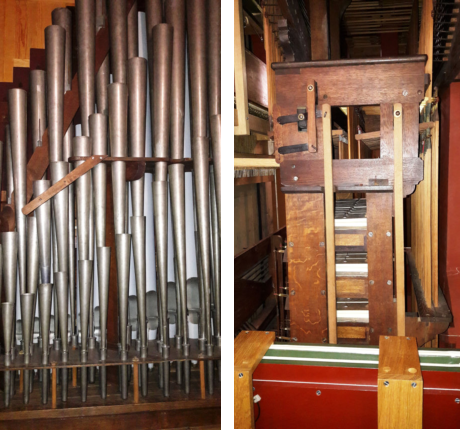
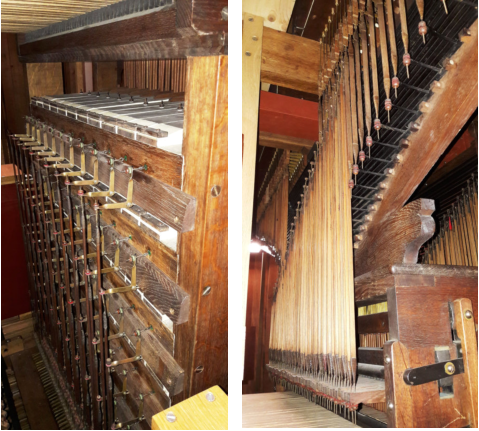
In 2017, Denis Lacorre and Laurent Plet completed a
comprehensive restoration, with the aim to restore the
original concept of Cavaillé-Coll. The missing stops were
reconstructed, including the Physharmonica (today called
Aeoline) and moved stops were repositioned to their
original places. All mechanics and the wind supply were
restored and the swell was moved to its original location in
order to regain the balance desired by Cavaillé-Coll. In
addition, the original II-II coupler and ‘tonnerre’ (pédale
d’orage) were reconstructed and the rear side of the organ
was provided with a new case to meet the conditions in
Gerbéviller.
Site of the organ


Titular organist
Thomas Monnet & Lucile Dollat
Parish website
Video
Thomas Monnet
Photos
organ: Victor Weller
1865 - Cavaillé-Coll (1)
1913 - Mutin (5)
1976 - Jean Jonet (3b)
2015 - Denis Lacorre & Laurent Plet (5)
III/37 - mechanical traction
Composition








Organs of Paris


ORGANS OF PARIS © 2026 Vincent Hildebrandt
C3
1865
The grand organ of Saint-Maurice was originally built in 1865
by Aristide Cavaillé-Coll for the private chapel of the Marquis
Ernest-Marie-Charles de Lambertye in Gerbéviller (Meurthe-
et-Moselle).
The organ was built in 1865 by Aristide Cavaillé-Coll for the
palatine Chapel of the marquis de Lambertye in Gerbéviller.
Since this instrument was not intended for a church, Cavaillé-
Coll could give free rein to his creativity. The instrument had a
Physharmonica, a stop designed by the German builder
Walcker: a free reed without pipes, as in a harmonium. There
was also a swell box with two opposed shutters, one opening
while the other closes, creating an effect of moving away from
the sound, as in a German Fernwerck. There were also
German influences in the stoplist, as evidenced by the names
of some stops. Cavaillé-Coll used in this organ for the first
time expression pedals, instead of the spoon like devices
used before.
Ernest-Marie-Charles de Lambertye died on 23 February
1904; his nephew and heir then decided to part with the
organ, which was considered cumbersome, in order to
improve the financial situation somewhat. It was purchased in
1909 by Canon Oudin and installed in t
he new church of Saint-Maurice in Bécon-les-Bruyères. The
instrument was transferred there by Mutin in 1912-1913,
after some alterations (changes to the internal layout and
probably to the wind pressures).
After 1925, the Physharmonica disappeared.
In 1976, the organ builder Jean Jonet carried out some
unfortunate modifications that shifted the instrument’s
specification toward the then-fashionable neo-classical style.
In 2017, Denis Lacorre and Laurent Plet completed a
comprehensive restoration, with the aim to restore the
original concept of Cavaillé-Coll. The missing stops were
reconstructed, including the Physharmonica (today called
Aeoline) and moved stops were repositioned to their original
places. All mechanics and the wind supply were restored and
the swell was moved to its original location in order to regain
the balance desired by Cavaillé-Coll. In addition, the original
II-II coupler and ‘tonnerre’ (pédale d’orage) were
reconstructed and the rear side of the organ was provided
with a new case to meet the conditions in Gerbéviller.
Site of the organ
1865 - Cavaillé-Coll (1)
1913 - Mutin (5)
1976 - Jean Jonet (3b)
2015 - Denis Lacorre & Laurent Plet (5)
III/37 - mechanical traction
Composition
Titular organist
Thomas Monnet & Lucile Dollat
Parish website
Video
Thomas Monnet
Photos
organ: Victor Weller
